Cleaning 1930s Suburban Semi Roofs: A South London Guide
If you live in Morden, Carshalton, Cheam, or half the streets of Bromley, your house is probably a 1930s semi. You know the look: bay window at the front, pebbledash or brick, and a hipped tiled roof that slopes on three or four sides. Those roofs are now getting on for a hundred years old, and they need a bit of care.
The tiles up there have weathered nearly a century of London rain, and they collect moss in ways a modern roof does not. Cleaning them well means understanding how they were built. Here is what makes a 1930s South London roof tick, and how to keep it sound without wrecking the tiles.
The quick answer: Most 1930s semis in South London have hipped roofs covered in clay tiles, now porous with age and quick to grow moss. They should be soft washed at low pressure, never blasted, because old clay cracks and the interlocking joints let water in. Keep the valleys and gutters clear and the roof lasts decades longer.
1. The 1930s semi is everywhere in South London
There is a reason these houses line so many South London streets. When the Northern line pushed out to Morden in 1926, the fields beyond turned into suburbs almost overnight. Builders threw up mile after mile of semis for families moving out of the crowded inner city, and the same thing happened across Sutton, Merton, and the edges of Bromley and Croydon.
The result is one of the most consistent housing types in the capital. If your road was built between the wars, your neighbours almost certainly have the same roof you do, with the same quirks and the same weak spots. What is true for one is usually true for the whole street.
2. What those roofs are actually made of
Nearly all of these roofs are clay tile. In the 1930s, concrete tiles had not taken over yet, so builders reached for plain or interlocking clay, usually in red or a browny orange that has faded over the decades. Underneath sits timber and, if you are lucky, a layer of original felt that is now brittle.
Clay is a good material. It lasts, it looks right, and it ages with a soft weathered colour. But old clay is porous. Its surface has lost the hard skin it had when new, so it drinks up water and holds it, which is the first thing moss looks for.
3. Why interwar tiles collect moss
Walk down any interwar street in autumn and you will spot it: green fuzz creeping across the north-facing slopes, thick in the tile laps. Ninety years of weather has roughened those tiles, and rough, damp tiles are a moss buffet.
South London does not help. The suburbs here are green and leafy, with mature street trees shading roofs and gardens, and all that shade keeps tiles wet for longer after rain. A 1930s roof under a big lime or horse chestnut will grow moss far faster than one out in the open.
4. Hipped roofs, valleys and where trouble hides
The hipped roof is the signature of the 1930s semi, and it is mostly a good thing. Sloping on all sides sheds water well and stands up to wind. But those slopes meet at hips and, where extensions or bays join, at valleys, and valleys are where problems gather.
A valley is a channel that carries a lot of water off two roof slopes at once. Fill it with moss, leaf litter, and grit washed down from the tiles and it stops draining. Then water backs up under the tiles either side, and you get a leak that shows up on a bedroom ceiling with no obvious cause. Keeping the valleys clear is half the battle on these roofs.
5. The pressure-washing mistake on old clay
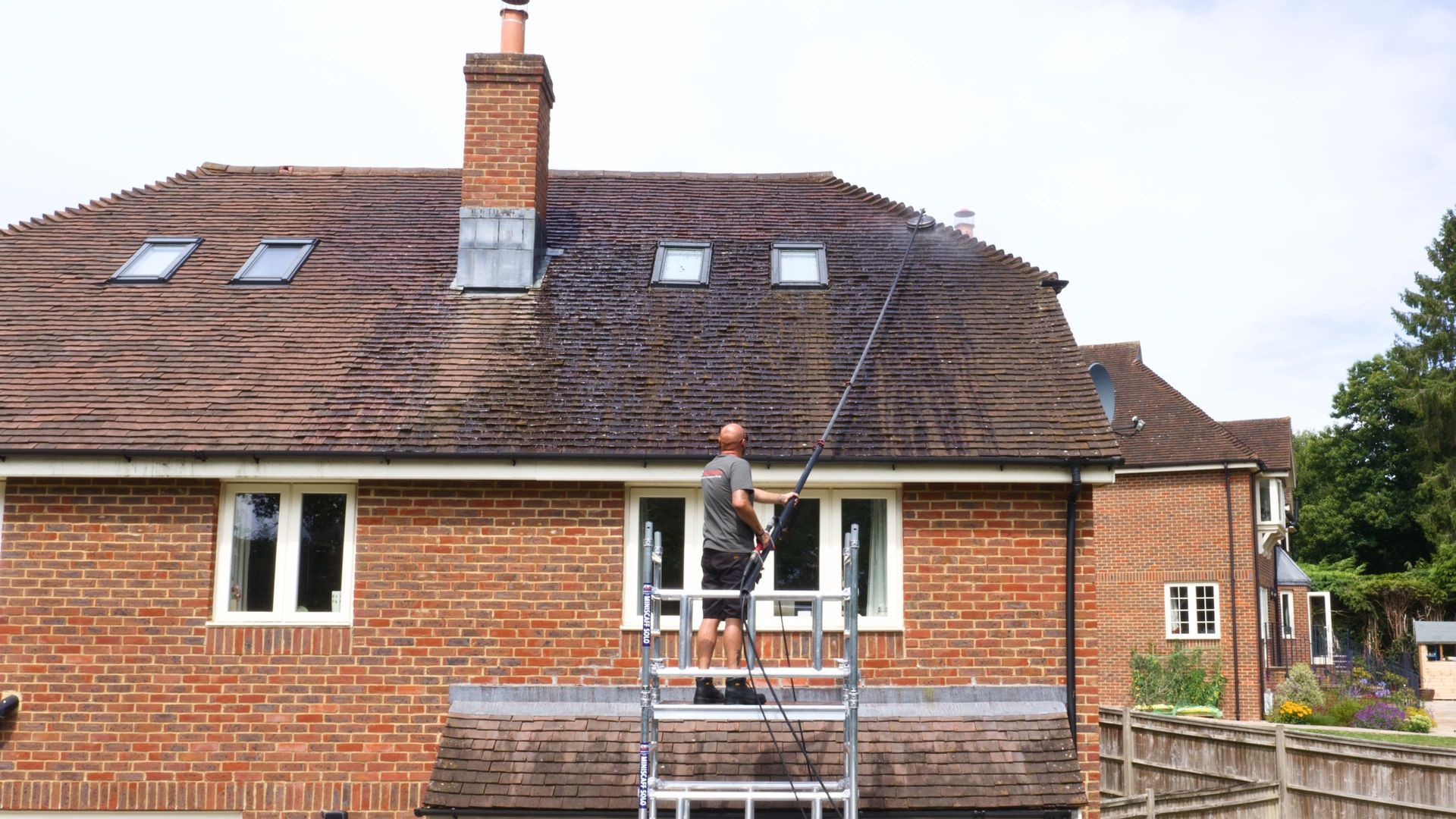
Every so often someone offers to blast a mossy roof clean with a pressure washer for a tempting price. On a 1930s clay roof, that is a fast way to turn a cleaning job into a re-roofing bill.
The high-pressure water strips what is left of the tile's surface, leaving it even more porous than before. It forces water under the laps and into that brittle old felt. And it can crack or dislodge tiles that have sat happily for decades. The moss comes back quicker too, because the roughened tiles hold more water. Soft washing does the job without any of that harm.
6. Keeping a 1930s roof in good order
These roofs reward a bit of routine attention. A soft wash clears the moss and a biocide treatment keeps it slow for a few years. Clearing the valleys and gutters each autumn stops water backing up. And a look over the ridge tiles now and then catches loose mortar before it lets water in.
None of it is dramatic or expensive on its own. Skip it for a decade, though, and the small jobs turn into big ones. A well-kept interwar roof can run for another fifty years. A neglected one starts leaking and shedding tiles far sooner.
Signs a 1930s South London roof needs attention:
- Green moss thick on the shaded slopes: old clay is holding water and feeding growth.
- Grit or tile fragments in the gutters: the tile surface is breaking down with age.
- Damp patches on upstairs ceilings near a valley: a blocked valley may be backing water up under the tiles.
- Slipped tiles on the hips or main slopes: old nails and mortar are giving way.
- Plants growing in the gutter line: years of debris have built up and need clearing.
Frequently Asked Questions
How do I know if my roof is the original 1930s clay?
If the tiles look faded, slightly uneven, and have a soft red or brown tone all the way through, they are likely original clay. Uniform, grey, or heavily streaked tiles usually mean a later concrete replacement.
Why does moss grow so much faster on my roof than my neighbour's?
It usually comes down to shade and aspect. A slope that faces north or sits under a tree stays damp for hours longer, which is exactly what moss needs. Same house type, different amount of sun.
Are the valleys really that important?
Yes. Valleys carry water off two slopes at once, so a blocked one causes leaks that are hard to trace. On hipped 1930s roofs with extensions, keeping the valleys clear prevents a lot of interior damp.
Can these old tiles be cleaned safely, or should I just replace them?
Old clay usually cleans up well with soft washing, and there is no need to replace tiles that are still sound. Cracked or badly spalled ones can be swapped individually while the rest are cleaned.
How often should a 1930s roof be cleaned?
Every few years for the moss, depending on shade and tree cover, with a yearly gutter and valley clear. Roofs under heavy tree cover need looking at more often than open ones.
Got a 1930s semi that needs some care?
Ben's Roof Cleaning cleans and maintains interwar roofs across South London, with over 15 years of experience. Get in touch or call 020 3435 9666
for a free, no-obligation quote.
Looking after the suburbs' favourite roof
The 1930s semi has aged better than almost anything else built since, and the roof is a big part of why. Clay tiles, hipped slopes, and honest construction were made to last, but only if the moss is kept off and the water kept moving. Treat the roof gently, clear the valleys, and your interwar semi will shrug off South London weather for decades more.